Why did megalodon die out?
No single cause, probably. A cooling planet, vanishing prey and a new rival.
How this site works. Every fact is in our own words and linked to its source, beside it. Megalodon is known almost only from teeth, so many numbers are estimates. Where good sources disagree, we show each version in a “Sources differ” box.
When?
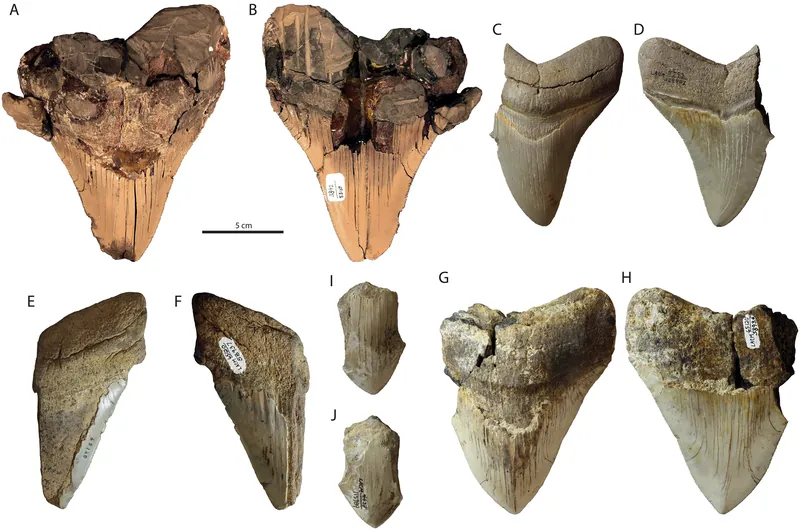
Megalodon teeth are only found in sea rocks 20 to 3.6 million years old. None younger has ever been found, so it went extinct 3.6 million years ago. NHM, still alive?
The same page talks of megalodon’s 16-million-year existence. NHM, still alive?
When did it die out? Sources differ
- The Natural History Museum also says megalodon was extinct by the end of the Pliocene, 2.6 million years ago, and that new evidence from the USA puts the last one at least 3.6 million years ago. NHM
- Smithsonian Ocean puts its disappearance from the fossil record around 2.6 million years ago. Smithsonian
- A 2019 study checked every late record on the Pacific coast of North America and found the youngest reliable ones are early Pliocene, pointing to extinction about 3.6 million years ago. Boessenecker et al. 2019
- Re-analysing a wider set of records gave a median extinction date of 3.51 million years ago, older than the 2.6 million years proposed before. Boessenecker et al. 2019
The 2.6 million figure is older; the 2019 re-check of the youngest fossils points to about 3.6 million years ago.
The same study says the extinction may not have happened at the same time everywhere. Boessenecker et al. 2019
Why?
A cooling planet
The planet was cooling. As adult megalodons depended on warm water, falling sea temperatures probably meant a big loss of habitat. NHM
Up to a third of all large sea animals, including 43% of turtles and 35% of seabirds, may have died out as temperatures cooled and numbers at the base of the food chain plummeted. NHM
Less food
Its prey may have died out too, or moved into cooler water where the sharks could not follow. NHM
Smithsonian Ocean links the end to the rising Isthmus of Panama, which cut the Caribbean off from the nutrient-rich Pacific, and the loss of prey. Smithsonian
No nurseries
As ice formed at the poles and sea level fell, the shallow coastal waters where pups were born would have been lost. NHM
A new rival
Competition with great white sharks for food may also have played a part. Studies of fossil teeth show that what the two ate overlapped. NHM
A 2022 study of zinc in fossil teeth found that, in the early Pliocene, great whites and megalodons living in the same places fed at a similar level in the food chain. McCormack et al. 2022
The 2025 study supports the idea that the arrival of the great white in the early Pliocene was at least partly to blame, through competition for food. Shimada et al. 2025
The 2019 study also suggests that ocean changes and cooling broke up its range, alongside competition with the newly evolved great white. Boessenecker et al. 2019
The great white’s ancestor lived at the same time as megalodon, and some scientists think the two competed. NHM
The answer so far
Exactly why megalodon went extinct is still being worked out, but there is mounting evidence for a mix of changing climate, falling prey numbers and competition. NHM, still alive?
Our view: megalodon was a giant that needed warm water and big prey. When both became harder to find, being the biggest may have become a weakness.