Megalodon vs the great white
Not a giant great white, and probably not even its close cousin.
How this site works. Every fact is in our own words and linked to its source, beside it. Megalodon is known almost only from teeth, so many numbers are estimates. Where good sources disagree, we show each version in a “Sources differ” box.
Related, or not?
How closely were they related? Sources differ
- For a long time people thought megalodon was a relative of the great white. The museum’s expert says we now know it came from a different lineage of shark, and was the last member of it. NHM
- Smithsonian Ocean says modern studies show megalodon was more closely related to an ancestor of mako sharks than to the great white. Smithsonian
- Britannica notes that the debate is not over: some palaeontologists still put megalodon in the same lineage as the great white because of their serrated teeth, while others put it with the megatooth sharks. Britannica
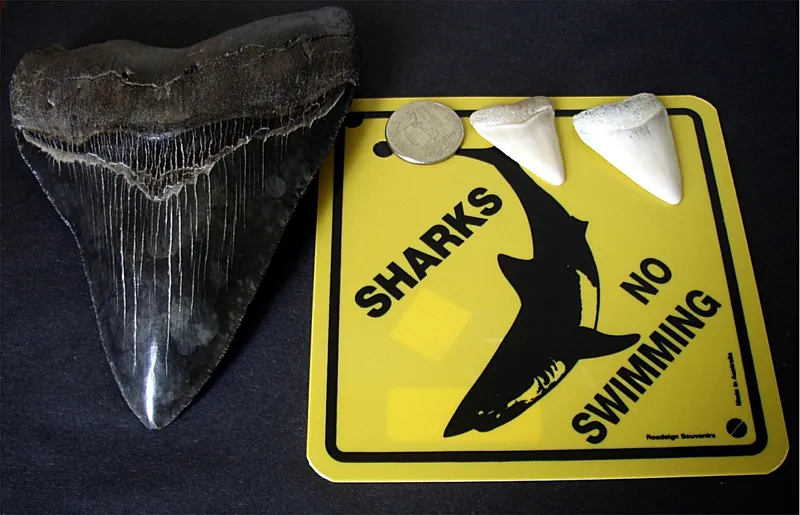
Like a great white’s, megalodon teeth are triangular, serrated and symmetrical. Britannica
Their similar serrated teeth may be convergent evolution: similar features evolving separately in different lineages. Britannica
Side by side
| Feature | Megalodon | Great white |
|---|---|---|
| Length | Older length estimates, based on tooth size, suggest a maximum of 15 to 18 metres. NHM A 2025 study by 29 fossil shark experts found that megalodon may have grown up to 24.3 metres long. NHM | That is about four times longer than the largest recorded great white, and a few metres longer than the biggest whale shark, measured at 18.8 metres. NHM |
| Weight | A shark that size may have weighed about 94 tonnes and cruised at around 2.1 to 3.5 km an hour. Shimada et al. 2025 | Britannica gives adult weights from about 30 tonnes to more than 65 tonnes. Most great whites weigh 680 to 1,800 kg. Britannica |
| Teeth | Britannica gives the largest known tooth as 17.8 cm, almost three times the usual 5.4 cm of a great white’s tooth. Britannica | The largest megalodon tooth ever found is almost 18 cm long. Great white teeth are usually about 5 cm. NHM |
| Bite | Smithsonian Ocean says a megalodon bite could have reached about 40,000 pounds of force, which would be the strongest bite in the whole animal kingdom. Smithsonian | A human bite has been measured at around 1,317 newtons and a great white’s predicted at 18,216 N. Megalodon’s is estimated at 108,514 to 182,201 N. NHM |
| When | The earliest megalodon fossils date to 23 million years ago, and it became extinct 3.6 million years ago. NHM | The 2025 study supports the idea that the arrival of the great white in the early Pliocene was at least partly to blame, through competition for food. Shimada et al. 2025 |
| Body shape | Scaled up to megalodon’s size, a great white would probably struggle to swim, so scientists suggest a much slimmer body, perhaps shaped like a lemon shark’s. NHM | Most reconstructions show megalodon as an enormous great white shark. The Natural History Museum says this is now believed to be wrong. NHM |
Rivals
The great white’s ancestor lived at the same time as megalodon, and some scientists think the two competed. NHM
A 2022 study of zinc in fossil teeth found that, in the early Pliocene, great whites and megalodons living in the same places fed at a similar level in the food chain. McCormack et al. 2022
Competition with great white sharks for food may also have played a part. Studies of fossil teeth show that what the two ate overlapped. NHM
Deep divers
Great whites have been recorded diving to around 1,000 metres. NHM, still alive?
Find out how great whites live today on sharks.animals.im’s great white shark page.
Our view: comparing megalodon with a great white is natural, because they look alike in films. The sources suggest the likeness is mostly in the teeth.