What was megalodon?
A giant shark of the Miocene and Pliocene seas, known almost entirely from its teeth.
How this site works. Every fact is in our own words and linked to its source, beside it. Megalodon is known almost only from teeth, so many numbers are estimates. Where good sources disagree, we show each version in a “Sources differ” box.
The name
The word megalodon means “giant tooth”: it is made from Greek root words. Britannica
The Natural History Museum translates the name simply as ‘large tooth’. NHM
Its scientific name today is Otodus megalodon. It used to be called Carcharodon megalodon or Carcharocles megalodon. NHM
Megalodon was first described in 1835 by the Swiss-born naturalist Louis Agassiz, who named it Carcharodon megalodon. Britannica
The short name megalodon is also the name of a genus of clams, which can cause confusion among scientists. Smithsonian
The biggest fish of all?
It is considered the largest shark, and the largest fish, that ever lived. Britannica
The Natural History Museum is a little more careful: the biggest shark in the world, and one of the largest fish ever to exist. NHM
When did it live?
Sources differ on the dates
- The earliest megalodon fossils date to 23 million years ago, and it became extinct 3.6 million years ago. NHM
- Smithsonian Ocean says it lived roughly 23 to 3.6 million years ago in nearly every corner of the ocean. Smithsonian
- Britannica dates megalodon fossils from the early Miocene, which began 23.03 million years ago, to the end of the Pliocene, 2.58 million years ago. Britannica
All agree on a start about 23 million years ago. The end is less certain; the extinction page sets out the evidence.
Family tree
Megalodon belonged to the lamnoid sharks (Lamniformes), the group that also includes great whites, makos and threshers. Smithsonian
Who were its closest relatives? Sources differ
- For a long time people thought megalodon was a relative of the great white. The museum’s expert says we now know it came from a different lineage of shark, and was the last member of it. NHM
- Smithsonian Ocean says modern studies show megalodon was more closely related to an ancestor of mako sharks than to the great white. Smithsonian
- Britannica places it in the extinct family of megatooth sharks, the Otodontidae. Britannica
- Britannica notes that the debate is not over: some palaeontologists still put megalodon in the same lineage as the great white because of their serrated teeth, while others put it with the megatooth sharks. Britannica
- A 2020 study points out that the two species probably belong to different families, so using the great white as the only model for megalodon’s size can be a problem. Cooper et al. 2020
Their similar serrated teeth may be convergent evolution: similar features evolving separately in different lineages. Britannica
The oldest definite ancestor of megalodon is Otodus obliquus, a 55-million-year-old shark that grew to about 10 metres. NHM
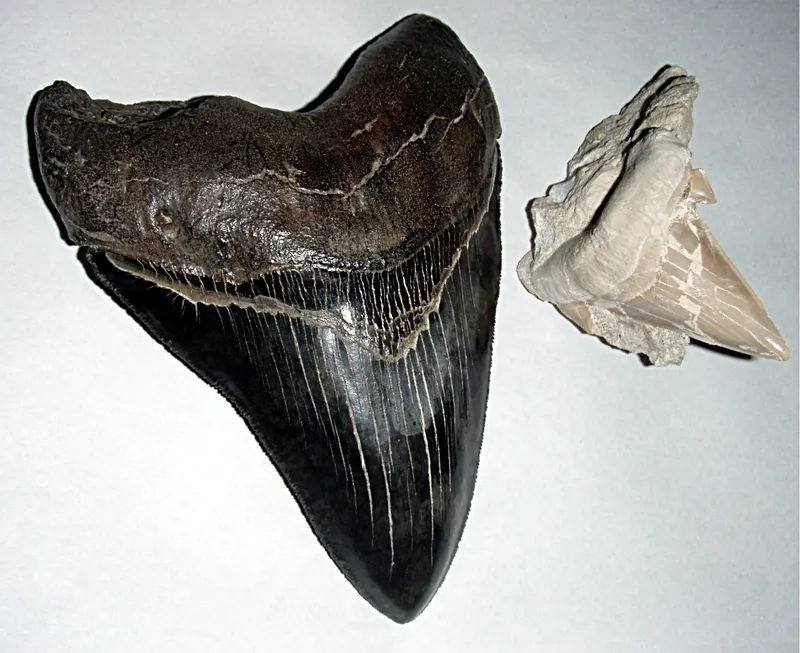
The lineage may go back to a Cretalamna shark 105 million years ago, which would make it more than 100 million years old. NHM
Smithsonian Ocean dates the start of megalodon’s lineage to about 60 million years ago, and says even its earliest member was longer than a great white. Smithsonian
Megalodon’s nearest living relatives are open to debate, but the mako is one candidate. Read more about makos on sharks.animals.im’s mako shark page.
A skeleton that didn’t survive
Like other sharks, its skeleton was mostly cartilage, the same bendy material as in your nose and ears. Cartilage is lighter than bone but very hard to fossilise. Smithsonian
So most of what we know comes from its teeth, its vertebrae (which contain calcium and so are preserved) and fossilised poop. Smithsonian
No one has ever found a complete megalodon skeleton. NHM
Britannica says it is known from hundreds of fossil teeth, two vertebral columns and a handful of single vertebrae. Britannica
Fossil megalodon vertebrae about the size of a dinner plate have been found. NHM
A megalodon skull reported from Peru apparently has a crushed braincase, all its teeth and a short string of vertebrae, but the museum’s expert had not yet seen good pictures of it. NHM
What shape was it?
Its body shape is worked out from living sharks, because the skeleton is missing. Smithsonian
Most reconstructions show megalodon as an enormous great white shark. The Natural History Museum says this is now believed to be wrong. NHM
Scaled up to megalodon’s size, a great white would probably struggle to swim, so scientists suggest a much slimmer body, perhaps shaped like a lemon shark’s. NHM
It probably also had a much shorter snout than a great white, a flatter jaw and extra-long pectoral fins to carry its weight. NHM
Bulky or slim? Sources differ
- Britannica still gives the older picture as well: a bulky, torpedo-shaped fish with a cone-shaped snout, large fins and a crescent-shaped tail, like a great white. Britannica
- A 2025 study by 29 fossil shark experts concluded that megalodon could have had a slender body, because a stout, great-white-like body at that size would have cost too much energy to push through the water. Shimada et al. 2025
- A 2020 study scaled up five living relatives and suggested that a 16 m megalodon probably had a head about 4.65 m long, a dorsal fin about 1.62 m tall and a tail about 3.85 m high. Cooper et al. 2020
The 2020 study used the older, great-white-like picture; the 2025 study and the museum now favour a slimmer body.
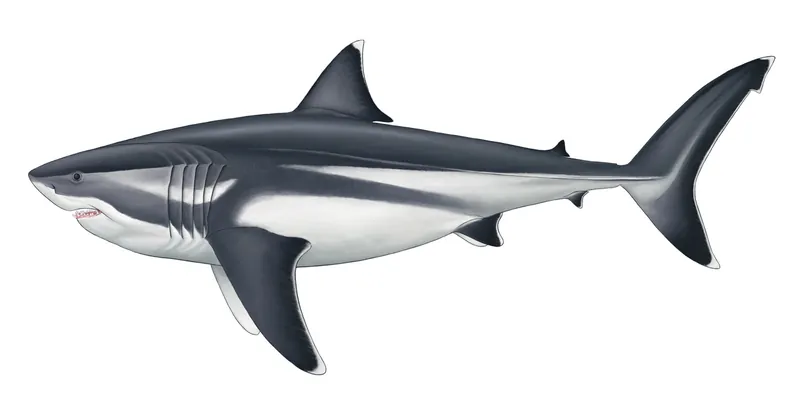
The 2025 authors call their ideas working hypotheses: reference points for future studies, not final answers. Shimada et al. 2025
Our view: it is remarkable how much has been worked out from teeth, a few backbones and comparisons with living sharks, and just as remarkable how much is still a best guess.
Next: the giant teeth →